
Traveling through SEA with medication or devices: what TSA allows
TSA lets you carry pills and medically necessary liquids over 3.4 oz through SEA security. Checkpoint hours, TSA Cares and who to ask for help.
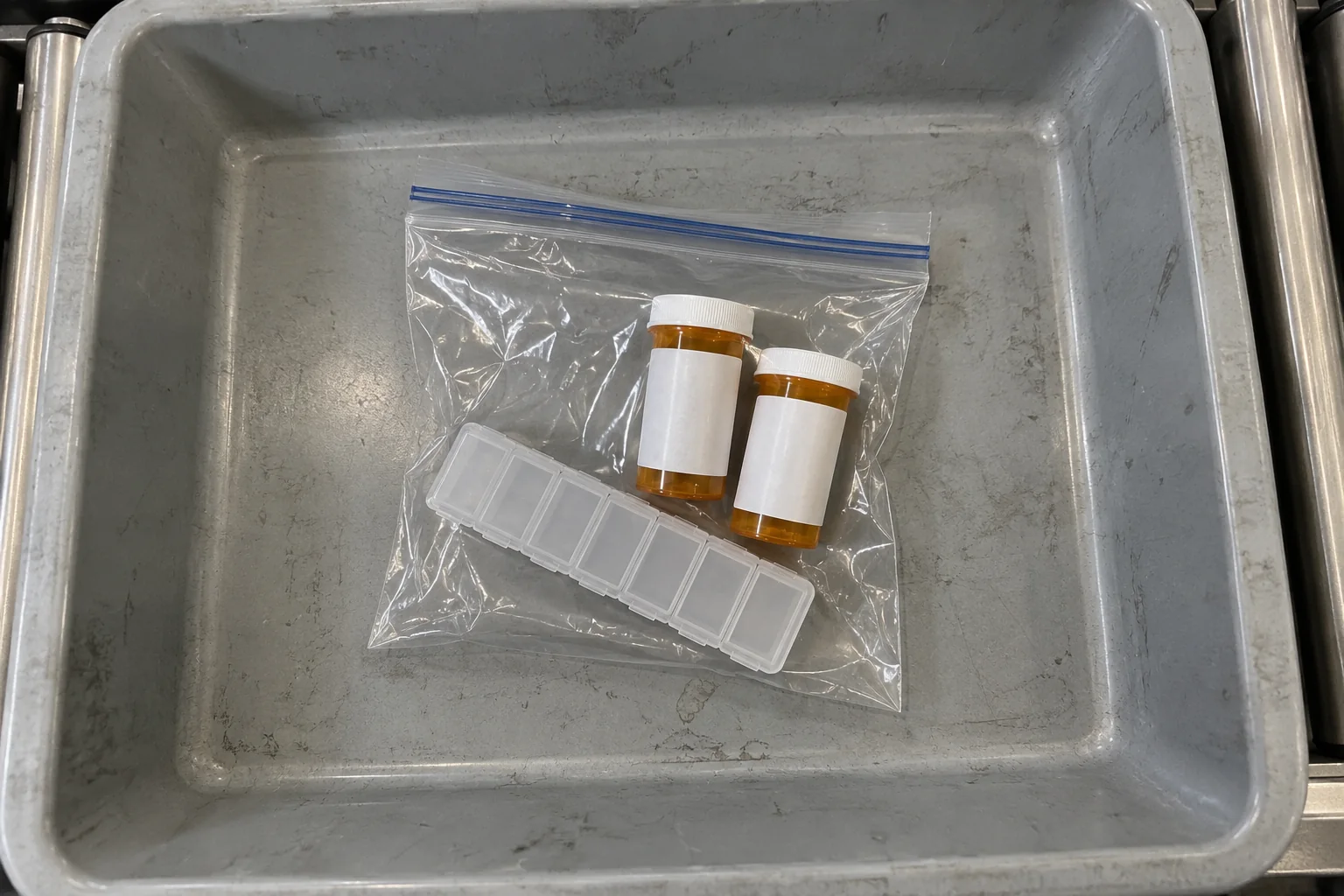
Yes, you can carry medication and medical devices through security at SEA. TSA screens every passenger here, and it allows pills in unlimited amounts and medically necessary liquids over 3.4 ounces in your carry-on. To plan ahead, call TSA Cares at (855) 787-2227 72 hours before you fly.
What TSA says about each item
The table follows TSA’s Medical page and its travel tips. The final decision on any item rests with the TSA officer at the checkpoint.
| What you’re carrying | Carry-on | What TSA says to do |
|---|---|---|
| Pills, capsules and other solids | Yes, unlimited amounts | They must be screened. You don’t have to show solids to an officer. TSA doesn’t require prescription bottles, but state labeling laws still apply, and TSA recommends labels. |
| Liquid medication, creams and gels over 3.4 oz | Yes, in reasonable quantities for the trip | Tell the officer at the start of screening. They don’t need the zip-top bag. Expect extra screening, which can include opening the containers. |
| EpiPens and inhalers | Yes | Declare larger amounts of liquid or aerosol. TSA recommends labels but doesn’t require them. |
| Nitroglycerin tablets and spray | Yes | TSA allows both. |
| Eye drops | Yes, 3.4 oz or less | TSA’s list gives 3.4 oz (100 ml) as the carry-on limit for eye drops. |
| Contact lens solution | Yes | Some solutions alarm and may not get through, so TSA recommends putting anything over 3.4 oz in a checked bag. |
| Blood sugar test kit | Yes | Tell the officer you have diabetes and are carrying supplies. |
| Insulin | Yes | Insulin pumps and supplies must travel with insulin, and TSA wants insulin in any form clearly identified. |
| Juice box or other liquid your condition requires | Yes, over 3.4 oz too | It gets additional screening. |
| Insulin pump or glucose monitor on your body | Yes | You won’t have to remove it. It gets extra screening, and you may do a self pat-down of the device followed by a hand test for trace explosives. |
| Bone growth stimulator, spinal stimulator, neurostimulator, port, feeding tube, ostomy | Yes, special instructions | Say what it is and where it sits before screening starts. If it can safely come off, TSA asks you to send it through the X-ray. If it can’t, expect additional screening, with careful and gentle inspection of sensitive areas. |
| Devices with lithium metal or lithium ion batteries | Carry-on only | TSA requires these in your carry-on. Most other battery devices can go in either bag. |
TSA also tells you to ask the device’s manufacturer whether it can pass through the X-ray, the metal detector or advanced imaging.
At the checkpoint, in order
- Tell the officer about liquids, and about any device on your body and where it sits, before screening. A TSA notification card is optional and describes your condition quietly.
- Ask for a visual inspection if you don’t want medication X-rayed. TSA says to ask before anything enters the X-ray tunnel.
- Take medically necessary liquids out of your carry-on. They’re screened separately from the rest of your bag.
- Pick your screening. Standard lanes may use advanced imaging, a metal detector or a pat-down. A lane without imaging, or a TSA PreCheck lane, may use a walk-through metal detector.
- Say so if you’d rather skip the technology, and the officer will do a pat-down. You can ask for private screening at any time.
- Ask for a Passenger Support Specialist or a Supervisory TSA Officer if you need help with screening.
TSA says officers may ask you to power up an electronic device, and a powerless device isn’t allowed on the aircraft.
Which checkpoint should you use?
TSA rules don’t change by checkpoint. Hours and crowds do. The Port says travelers can reach every gate from any checkpoint, so pick by the time you’re flying.
| Checkpoint | Listed hours |
|---|---|
| Checkpoint 1 | 4 a.m. to 8 p.m. |
| Checkpoint 2 | 4 a.m. to 4 p.m. |
| Checkpoint 3 | 4 a.m. to 11:30 p.m., with TSA PreCheck and Touchless ID 4 a.m. to 8 p.m. |
| Checkpoint 4 | Open 24 hours |
| Checkpoint 5 | 4 a.m. to 8 p.m. |
| Checkpoint 6 | 4 a.m. to 10 p.m. |
Checkpoint 4 is the only one that’s open before 4 a.m. Checkpoint 3 stays open latest of the five that close, until 11:30 p.m. Checkpoint 2 is the first to shut, so it’s the wrong pick for an afternoon departure.
CPAP machines and other questions
The battery rule in the table applies if yours runs on lithium batteries. Text “Travel” to AskTSA at 275-872, with live help from 8 a.m. to 6 p.m. Eastern, or call TSA Cares.
TSA Cares runs 8 a.m. to 11 p.m. Eastern on weekdays and 9 a.m. to 8 p.m. Eastern on weekends and holidays.
Who helps at SEA
- Customer Care: SEA’s Customer Care line is (206) 787-5388.
- Information desks: staffed by SEA Pathfinders and volunteers, who keep first-aid supplies. They sit on the ticketing level between Checkpoints 4 and 5, on the baggage claim level near Checkpoint 1 (both before security) and on the A Concourse between Gates A5 and A6 (after security).
- Emergencies: call or text 9-1-1. The Port of Seattle Police non-emergency line is (206) 787-5401, and defibrillators are placed throughout the terminal. Our medical and first-aid listing shows where the police and first-aid points are.
- Wheelchairs: Prospect Airport Services, at (206) 246-1550, covers the stretch from the Link station, baggage claim or garage to your airline’s ticket counter. Your airline covers everything after that. Our wheelchair assistance listing holds the pickup points.
Carry-on or checked bag?
TSA lets you pack medication in either bag and strongly recommends carry-on, in case you need immediate access.
Larger liquids that aren’t medicine follow the 3-1-1 rule.
Arriving from another country
CBP says medication you bring into the United States, prescription or over the counter, must comply with FDA rules. Controlled substances also fall under DEA rules. CBP adds that U.S. citizens should carry only medication prescribed by a licensed physician or legally obtained in the United States.
For visitors, CBP says to carry a valid prescription or a doctor’s note written in English, and to keep medication in its original container. Bring no more than you need, and CBP gives 90 days as a rule of thumb. Medicines that can be addictive, such as some cough medicines, tranquilizers, sleeping pills, antidepressants and stimulants, need all four of these:
- Declare them to CBP.
- Keep them in original containers.
- Carry only the amount a person with your condition would normally carry.
- Bring a prescription or written statement from your physician.
Questions about importing a medicine go to the FDA’s Division of Import Operations.
Connecting passengers from an international flight screen again at the IAF Transfers Security Checkpoint, listed 6 a.m. to 9:45 p.m. Pacific. It exits into the A Concourse, and TSA’s medication rules above apply there too.
If you run short or leave something behind
The airport’s directory tags several Hudson stores after security with pharmacy, and it says Hudson stores sell medicine. The Hudson in the Central Terminal is listed open around the clock. No pharmacy counter is listed.
The airport’s Lost and Found receives items left at a TSA checkpoint the next business day. Our lost and found guide covers the free online report and the office’s hours.
Sources
Our pages:
- Security checkpoints
- Wheelchair assistance
- Medical and emergencies
- Information desks
- Security wait times at SEA
- Food through security at SEA
- Lost something at Seattle airport
Official pages:
- TSA, What Can I Bring? Medical
- TSA, Travel Tips
- TSA, I am traveling with medication, are there any requirements I should be aware of?
- TSA Cares, Traveling With Medication (video page)
- CBP, Traveling with Medication to the United States